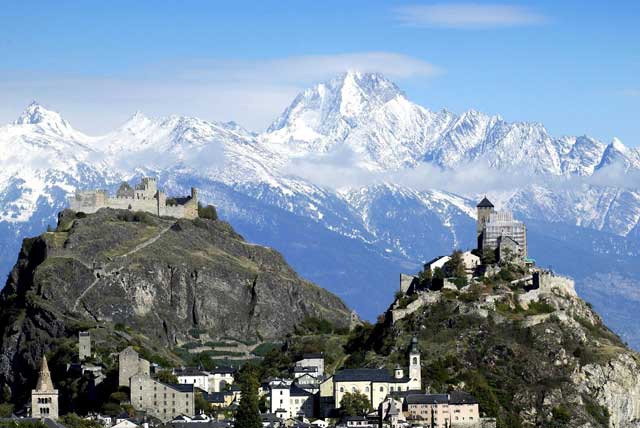
The Two Guarding Hills: Tourbillon and Valère
Sion’s landscape is famous worldwide because of its twin hills. They look like they belong in a fantasy movie, and each one has a different story to tell:
- Tourbillon Castle: Located on the higher, steeper hill, this 13th-century castle was the summer home of the powerful Bishops of Sion. Sadly, a massive fire destroyed it in 1788, but its impressive stone ruins still stand today. Climbing up to the top offers a 360-degree view of the entire valley.
- Valère Basilica: On the opposite hill sits a fortified church that looks like a castle. Inside this church lies one of the greatest musical treasures on Earth: the oldest playable organ in the world, built in 1430! Every summer, international musicians travel here to play during the International Antique Organ Festival.
The History: From Stone Age Secrets to Medieval Power
Sion’s history is a long adventure that spans thousands of years. It was a strategic prize that everyone wanted to control.
- The Stone Age and the Mystery of the Dolmens (6,000 years ago): Long before the pyramids of Egypt, prehistoric humans lived here. In the district of Le Petit-Chasseur, archaeologists found ancient burial sites called dolmens (massive stone monuments) with beautifully carved standing stones.
- The Roman Settlement (Sedunum): When the Roman Empire expanded, they conquered the local Celtic tribe and renamed the town Sedunum. They used it as an important trading base because it sat perfectly at the base of the alpine passes leading directly to Italy.
- The Rise of the Prince-Bishops (The Middle Ages): In the year 999, the King of Burgundy gave total control of the region to the Bishop of Sion. The bishops became Prince-Bishops—religious leaders who also had the political power of a king. They built the massive Tourbillon Castle to protect themselves from their rivals.